Memorial Eye

                            Doctors of Optometry

Experts in EyeCare    


Buy Contact Lenses Online at ShipMyContacts.com


REFRACTIVE ERRORS


Refractive Errors are flaws in which the eye does not naturally refract (bend) light to focus properly on the retina, or more specifically, the macula.

Refractive errors are not diseases; if an eye has a refractive error, it simply means that the eye has a normal variation in shape. The degree of this variation determines whether or not corrective lenses are needed.

Corrective lenses do not 'cure' refractive error; rather, the lenses make light focus properly.

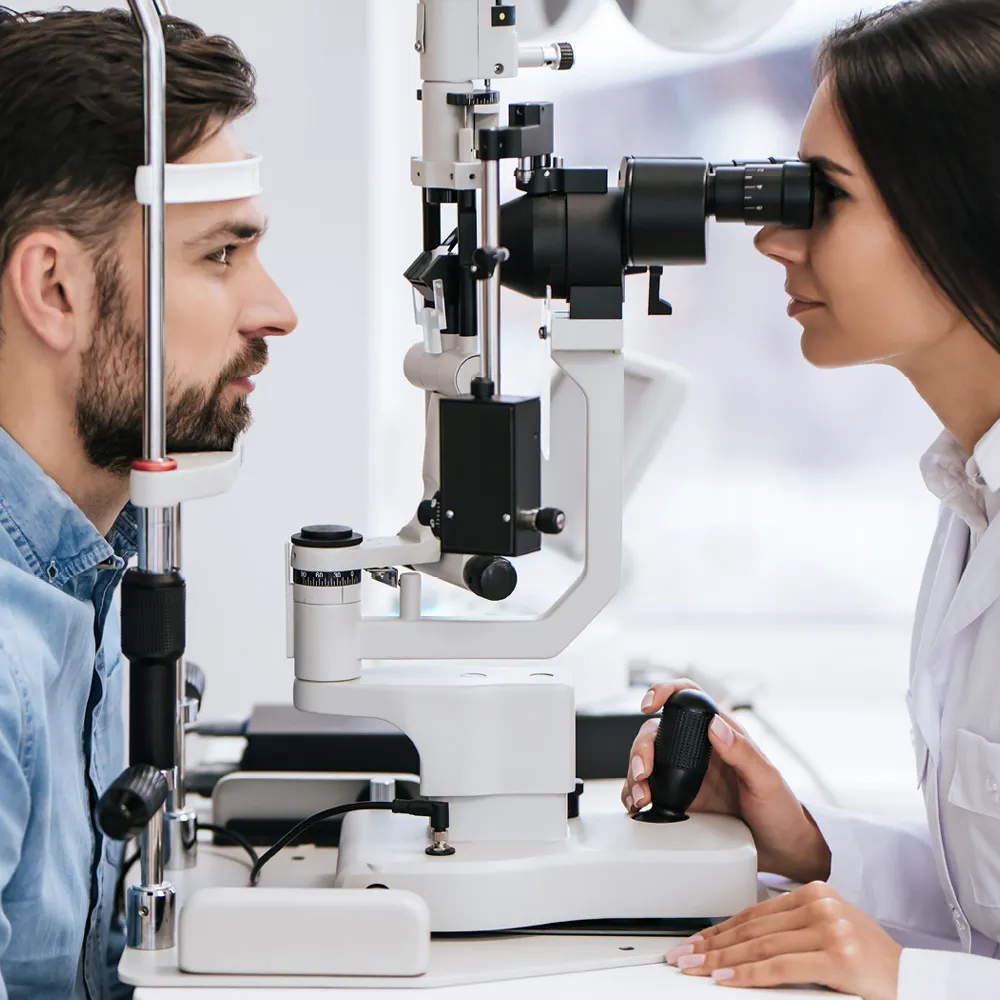
A comprehensive eye examination will detect these and other eye problems. After these problems have been discovered, periodic examinations indicate whether or not these conditions are growing worse and whether or not a change in prescriptive eyewear is needed. Eye exams also help to ensure that vision impairments do not interfere with daily activities.

There are four types of refractive error:


MYOPIA (Nearsightedness)

A person with nearsightedness can see nearby objects well, but not objects at a distance.

Myopia occurs either because the eyeball is more elongated, as opposed to round, or the front surface of the cornea has a greater degree of curvature than a "perfect" eye.

Because of these two distinctions, light from distance objects comes to a focal point in front of the retina. When the light actually reaches the retina, it is blurred equally in all directions, somewhat like a starburst. Concave lenses are used to make light focus properly.

The onset of myopia generally begins between the ages of 6 to 12, and while the body grows, the degree of myopia generally increases. Once an individual reaches his or her early to mid 20's, myopia generally levels off.

The main symptom is the inability to see distance objects, such as road signs, TV screens, overhead projector displays, or chalkboard writing. An individual may squint to attempt to see more clearly.

Treatment options include spectacles, contact lenses, or LASIK (laser surgery).


HYPEROPIA (Farsightedness)

Hyperopia is often referred to as "farsightedness". If a person is farsighted, he or she can focus more easily on distance objects than those that are more nearby.

The most common cause for farsightedness is that the eyeball is shorter from front to back than a perfect eye. Sometimes, it may also be because the cornea has a lesser degree of curvature than perfect.

For these two reasons, when light passes through this type of eye, there is not enough optical power to make the light focus on the retina. The focusing system inside the eye can often compensate and make light focus on the retina when small amounts of hyperopia are present, but when symptoms exist, corrective lenses are needed.

Because hyperopia causes the eye to exert extra effort, tension and discomfort can result, as well as blurred vision as the eye becomes fatigued. Symptoms include trouble concentrating or focusing on nearby objects such as books or newspapers. After long periods of viewing nearby things, blurred vision, nervousness, tension and irritability may result. An individual may not enjoy near work or reading, or with children, poor reading ability may result.

Comprehensive eye exams are important, particularly with children, because school screenings often do not detect hyperopia. Treatment options include spectacles, contact lenses, or LASIK (laser surgery).


ASTIGMATISM

Astigmatism is a very common problem. Most people who wear glasses or contact lenses for other refractive errors have some degree of astigmatism. Many more have it, but not enough to affect vision.

Astigmatism occurs when the cornea is not perfectly spherical in shape. This is as common as teeth that are not perfectly aligned. Rather than being shaped like the side of a basketball, a cornea with astigmatism is shaped more like the long side of a football. The exact reason for differences in corneal shape remains unknown, but the tendency to develop astigmatism runs in families, and can remain fairly constant throughout life.

Because of the distortion in curvature of the cornea, light rays entering the eyes from both distance and near objects do not come to a single focal point at the retina. Instead, two distinct points are formed, neither of which may be on the retina, resulting in vision that may be more like the view in a distorted, wavy mirror.

Symptoms of astigmatism include distortion or blurring of images at both far and near distances. Even when slight degrees of astigmatism are present that do not seem to affect vision, a person may experience headache, squinting, eye fatigue, or discomfort. Poor school work among children is also common, even when vision problems are not detected during routine school screenings.

Treatment options include spectacles, specialized contact lenses (either "toric" or "rigid gas permeable") or LASIK (laser surgery).


PRESBYOPIA

Presbyopia is an acquired refractive error that all people experience and has no known effective prevention. It is a process in which the lens inside the eye gradually loses elasticity, causing difficulty for the eye to focus on nearby things. It is usually first noticed when people reach their late 30's or early 40's.

Inside each eye, there is a crystalline lens. Around the lens are tiny focusing muscles. When the eye attempts to focus on near objects, the muscles contract, and the lens bends to focus light on the retina. This process is called "accommodation. As people age, the eye slowly loses the ability to accommodate, which affects the ability to see near things clearly, as well as quickly shifting focus from distance to near.

The most common symptom of presbyopia is holding reading material further away to see more clearly. Other symptoms include eye fatigue or headaches while reading printed material, or performing other near tasks, such as computer work or sewing.

Corrective lenses are prescribed to compensate for the focusing ability that the eye has lost. This near prescription may be combined with an existing prescription for other refractive error to form a bifocal or progressive addition lens (PAL). Contact lenses are also an option. Each patient should discuss his or her individual visual demands with the doctor to determine the best option.


<< Disorders of the Retina    |    Cataracts >>